

From ChatGPT to Claude and Grok: AI.cc’s One-API Solution Powers Next-Gen AI Agents and Applications
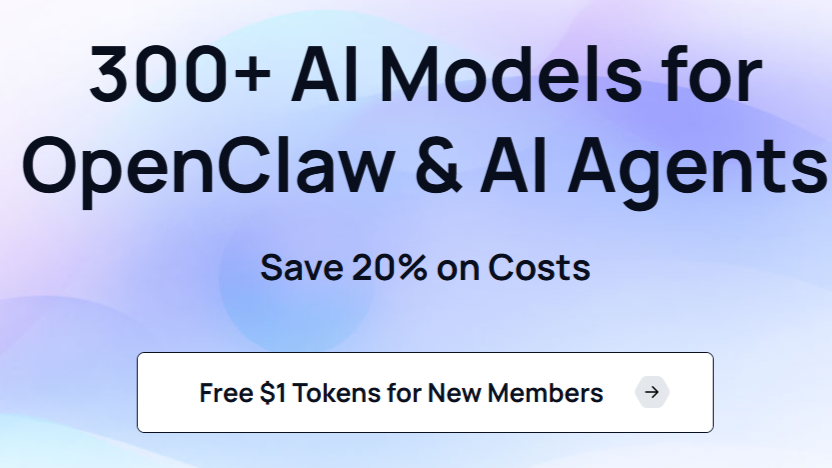
AI.cc (www.ai.cc) is enabling this shift by offering a true one-API solution that provides instant access to over 300 leading AI models — including OpenAI’s ChatGPT (GPT series), Anthropic’s Claude, xAI’s Grok, Google’s Gemini, and many others — through a single, standardized interface.
Why Multi-Model Strategies Are Becoming Essential
Each major model brings distinct advantages in 2026:
ChatGPT (GPT-5.4 series) remains a strong generalist with broad tool-calling support and ecosystem familiarity.
Claude 4.5 Opus excels in careful reasoning, long-context analysis, and high-quality writing or coding tasks.
Grok 4 stands out for real-time knowledge, bold creativity, and handling unconventional or humorous prompts.
Gemini 3 delivers superior multimodal understanding and research-oriented capabilities.
For next-generation applications — particularly autonomous AI agents that plan, reason, execute, and iterate — using only one model often leads to suboptimal results. The most advanced agentic workflows now route different subtasks to the best-suited model dynamically. Yet, directly integrating multiple providers creates friction: different authentication methods, inconsistent response formats, separate rate limits, and fragmented monitoring.
AI.cc Eliminates Integration Complexity with One API
AI.cc solves this by acting as a unified gateway. Developers keep their existing OpenAI-compatible code and simply change the base URL to https://api.ai.cc/v1, using one API key for everything.
Switching models requires only updating the model name in the request. New models from any supported provider become available quickly, allowing teams to adopt the latest releases without rewriting infrastructure.
This architecture supports:
Seamless orchestration of multiple models within a single agent workflow.
Low-latency responses and high concurrency suitable for production-scale agent deployments.
Centralized usage tracking and cost monitoring across all models.
The freedom to experiment and optimize without vendor-specific constraints.
Building Multi-Model AI Agents in Practice
Here is an updated example showing how easy it is to leverage different models for different stages of an agent workflow:
Pythonfrom openai import OpenAI
client = OpenAI(
base_url="https://api.ai.cc/v1",
api_key="your_ai_cc_api_key"
)
# Stage 1: Use Grok for creative brainstorming
brainstorm = client.chat.completions.create(
model="grok-4",
messages=[{"role": "user", "content": "Generate 5 innovative ideas for an AI research assistant"}]
)
# Stage 2: Use Claude for structured reasoning and planning
plan = client.chat.completions.create(
model="claude-4.5-opus",
messages=[{"role": "user", "content": f"Create a detailed execution plan from these ideas: {brainstorm.choices[0].message.content}"}]
)
print("Brainstorm:", brainstorm.choices[0].message.content)
print("Execution Plan:", plan.choices[0].message.content)
With this pattern, developers can construct sophisticated agents that intelligently combine creativity (Grok), deep analysis (Claude), general capabilities (ChatGPT), and multimodal processing (Gemini) — all without managing separate integrations.
Advantages for Developers and Enterprises
Teams adopting AI.cc’s one-API solution typically experience:
Dramatically faster prototyping and iteration when testing or combining new models.
Reduced engineering overhead, freeing developers to focus on agent logic, memory systems, and user experience rather than API plumbing.
Better overall performance by matching each task to the model that handles it most effectively.
Greater resilience, as applications can gracefully fallback or route around any single provider’s temporary issues.
This approach is particularly powerful for building agentic AI systems — autonomous agents capable of multi-step reasoning, tool use, and collaboration with other agents.
Traditional Multi-Provider Integration vs. AI.cc One-API
Model Switching: Requires new SDKs, keys, and code adaptations vs. Change only the model name
Workflow Complexity: Managing different response schemas and error handling vs. Consistent OpenAI-compatible format
Monitoring & Control: Fragmented dashboards and billing vs. Single unified view for all models
Adoption Speed for New Models: Delayed by integration work vs. Immediate availability
Agent Development Focus: Split between infrastructure and application logic vs. Pure focus on intelligent behavior
Enabling the Next Wave of AI Innovation
In 2026, the winners in AI development will be those who can fluidly combine the best capabilities from ChatGPT, Claude, Grok, Gemini, and beyond. AI.cc’s one-API solution provides the technical bridge that makes this multi-model future practical and scalable for both startups and large enterprises.
Developers ready to build more powerful AI agents and applications can sign up at www.ai.cc for a free API key and starter tokens. Full model list, detailed examples, and documentation are available to accelerate development.
For complete information on the one-API platform and supported models, visit https://www.ai.cc or the documentation at https://docs.ai.cc.
About AI.cc
AI.cc is a Singapore-based unified AI API platform that aggregates over 300 leading AI models into one simple, high-performance interface, helping developers create advanced multi-model agents and applications with ease.
AICC
AICC
+44 7716940759
support@ai.cc
Legal Disclaimer:
EIN Presswire provides this news content "as is" without warranty of any kind. We do not accept any responsibility or liability for the accuracy, content, images, videos, licenses, completeness, legality, or reliability of the information contained in this article. If you have any complaints or copyright issues related to this article, kindly contact the author above.
